Highlights
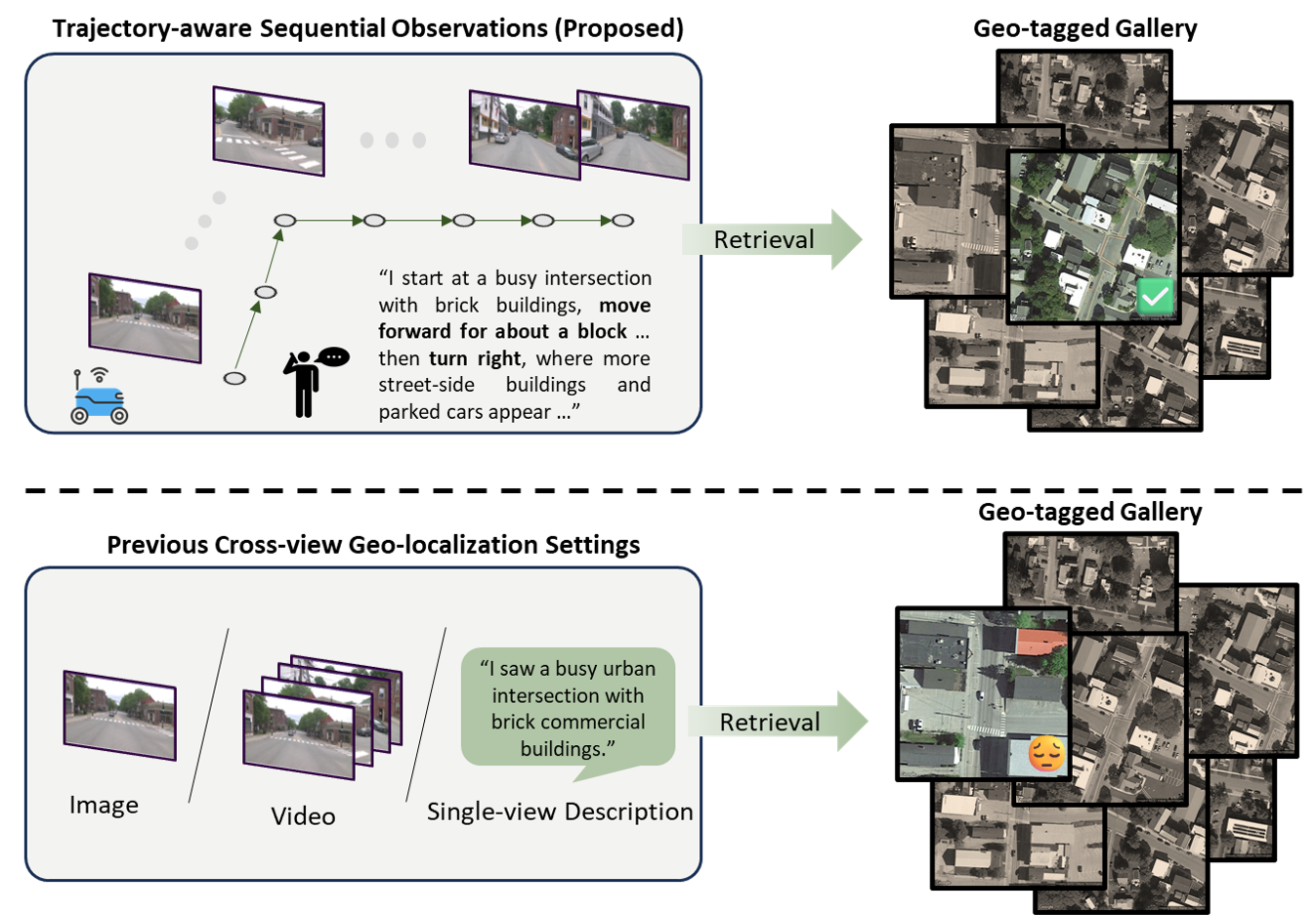
A Setting Prior Datasets Missed
Cross-view datasets are single-image, video-only, or text-only — never sequential and linguistic together. SeqGeo-VL pairs route video, route narrative, and satellite imagery: 38,863 triplets, 91.8% human-verified.
Jump to section 02 · MethodOur Unified Approach
TrajLoc is adapted directly from the pretrained CLIP — no bespoke temporal architecture. Query with a trajectory, video frames, plain language, or any mix.
Jump to section 03 · Looking AheadFrom Spatial-Reasoning Benchmark to Agentic Tool
Egocentric-to-allocentric matching in outdoor scenes still stumps strong MLLMs, and explicit geometric conditioning beats prompting by a wide margin — positioning TrajLoc as a specialized tool that agentic MLLMs can call.
Jump to sectionCan You Localize the Route?
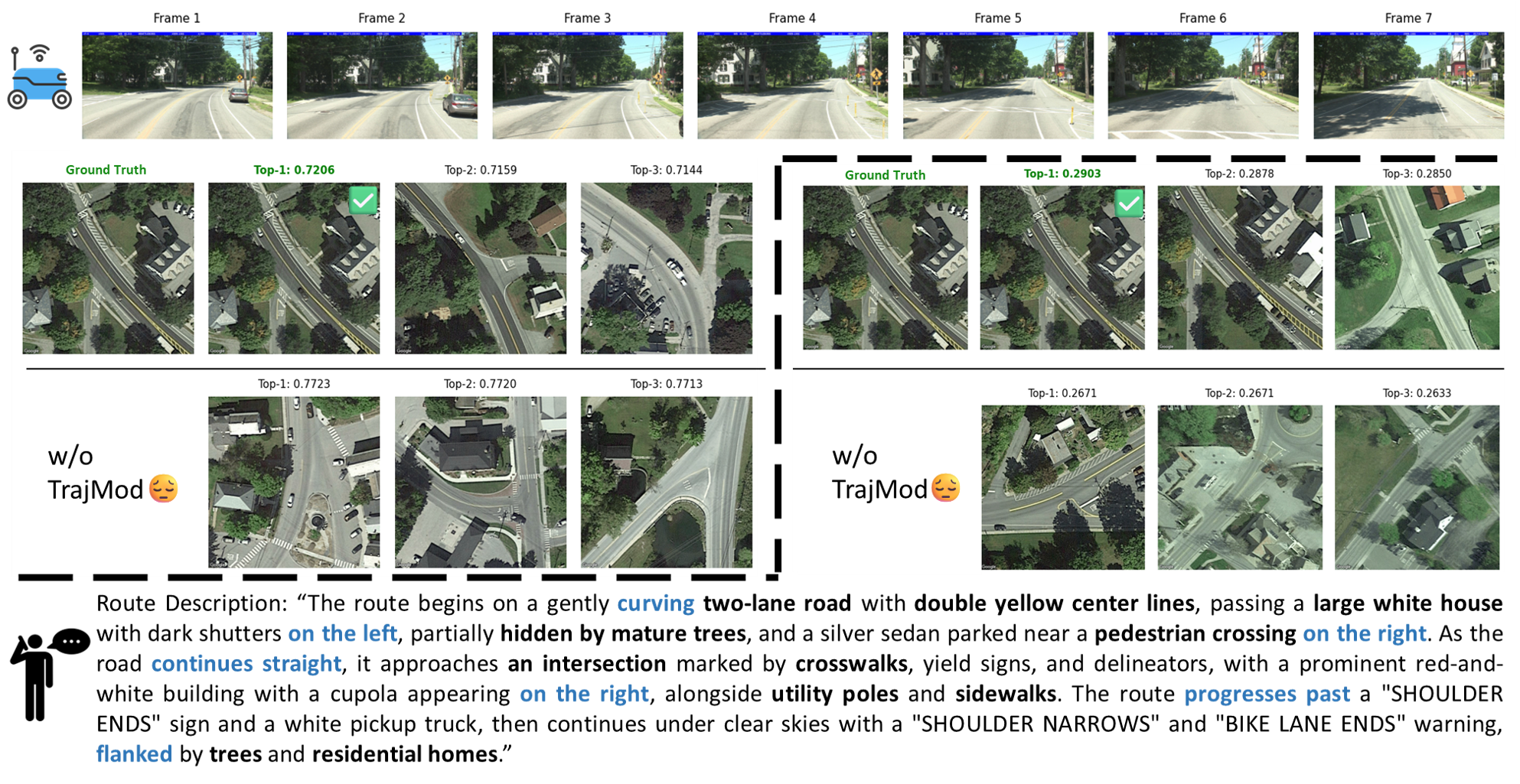
Watch a route play out at street level while its narrative unfolds line by line, then pick the satellite tile it traverses. Every route is drawn from SeqGeo-VL's held-out validation split.

Route narrative
Which satellite tile does this route traverse?
A Setting Prior Datasets Missed
Existing cross-view datasets are single-image, sequential-video, or single-image-plus-text — never sequential and linguistic together. We extend SeqGeo with a progressive VLM+LLM annotation pipeline to close that gap.
| Dataset | Text | Sequential | View Type | Queries | References | Obs. |
|---|---|---|---|---|---|---|
| CVUSA | ✗ | ✗ | Panoramic | ~1.5M | ~1.5M | ~1 |
| CVACT | ✗ | ✗ | Panoramic | 137K | 137K | ~1 |
| VIGOR | ✗ | ✗ | Panoramic | 105K | 90K | ~1 |
| CVGlobal | ✗ | ✗ | Panoramic | 134K | 134K | ~1 |
| University-1652 | ✗ | ✗ | Limited FOV | 5.5K | 90K | ~1 |
| GeoText-1652 | ✓ | ✗ | Limited FOV | 14K | 90K | ~1 |
| CVG-Text | ✓ | ✗ | Limited FOV | 30K | 60K | ~1 |
| KITTI-CVL | ✗ | ✓ | Limited FOV | 28K | 41K | ~4 |
| GAMa | ✗ | ✓ | Limited FOV | ~15M† | 1.9M | — |
| SeqGeo | ✗ | ✓ | Limited FOV | 118K | 38K | ~7 |
| SetVL480K | ✗ | ✗ | Limited FOV | 480K | 16K | ~4 |
| SeqGeo-VL (ours) | ✓ | ✓ | Limited FOV | 118K | 38K | ~7 |
Obs. is the average number of observations (frames) per query. † As reported by SetVL480K.
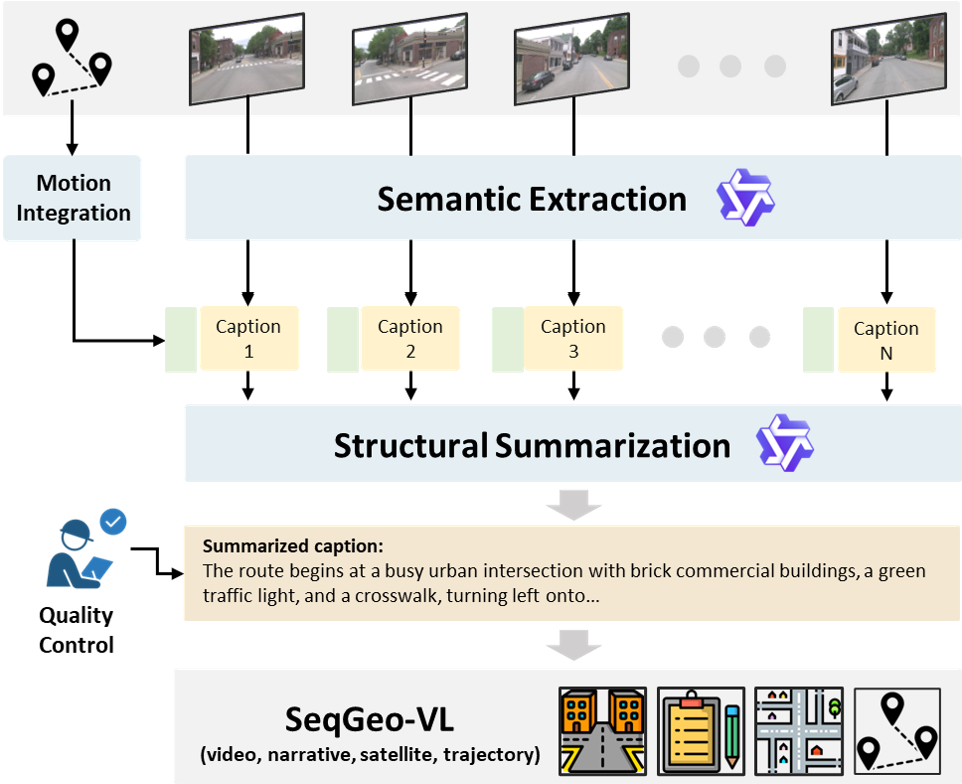
38,863 video–narrative–satellite triplets
Built from SeqGeo with a four-stage pipeline: per-frame semantic captioning, motion integration from trajectory metadata, LLM summarization into a route-level narrative, and human quality control.
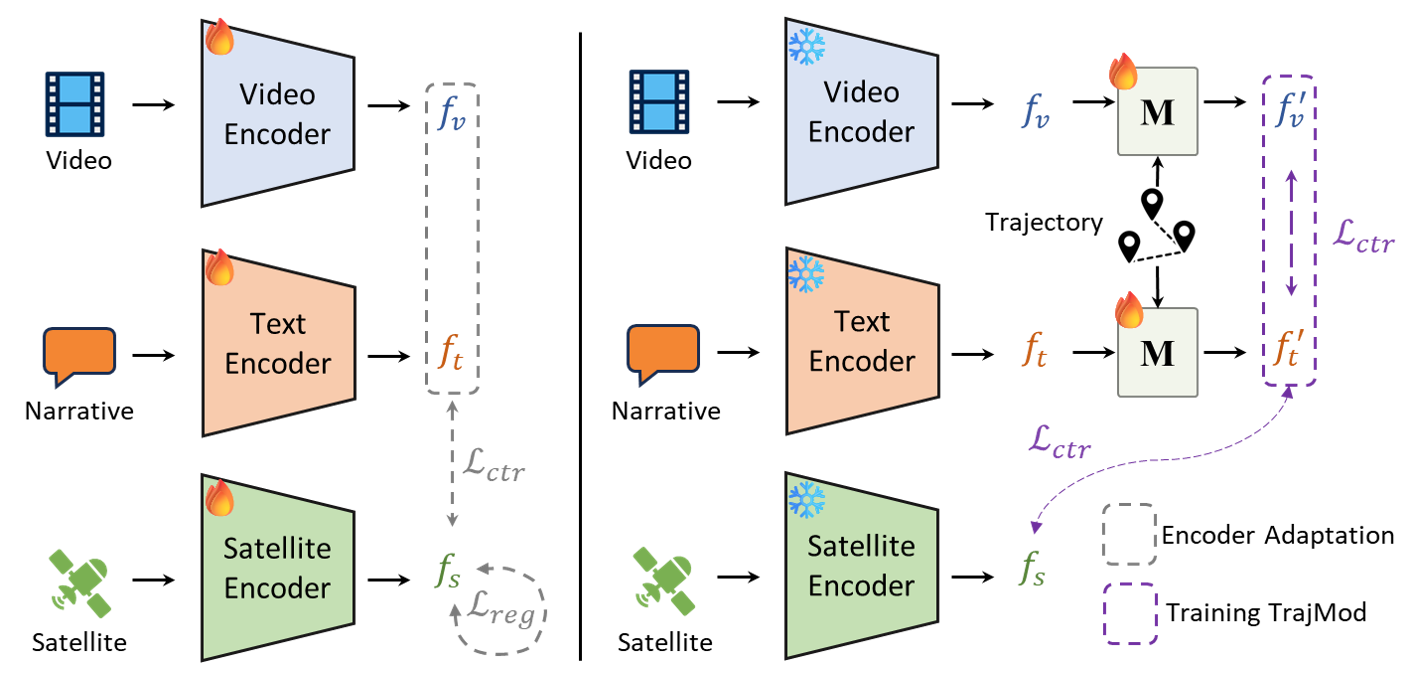
Our Unified Approach
TrajLoc turns one pretrained CLIP ViT-L/14 into video, text, and satellite encoders with a two-stage curriculum: Stage 1 grounds the satellite encoder in video semantics; Stage 2 aligns route descriptions while regularizing against satellite-feature drift.
τ = {(Δxᵢ, Δyᵢ, θᵢ)} — waypoint offsets and headings, no map or POI metadata — to scale/shift parameters that modulate the query embedding, f′ = γ ⊙ f + β.
State of the Art on Both Query Types
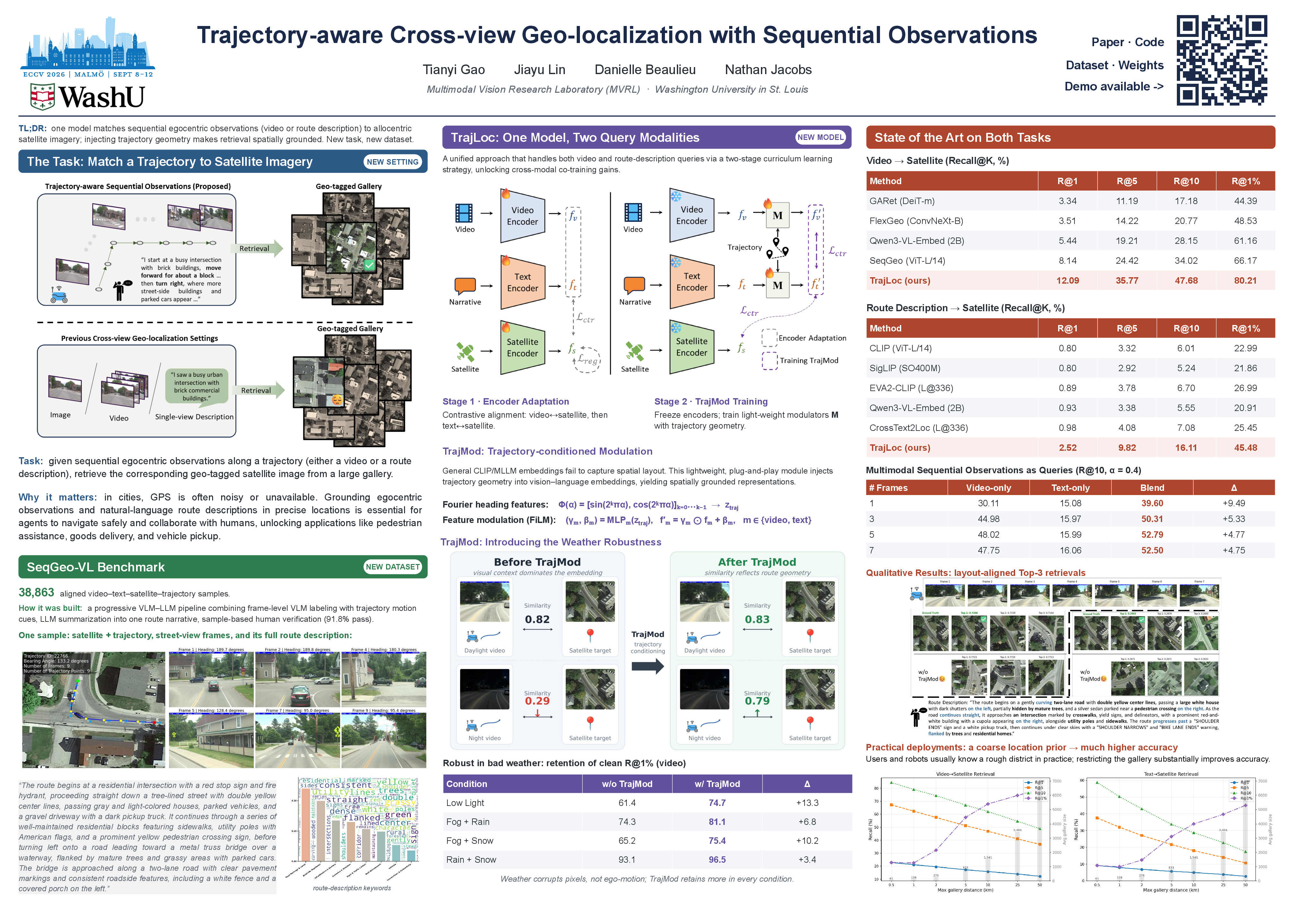
TrajLoc outperforms prior video- and text-based methods alike using the same ViT-L/14 backbone as its closest competitors, and beats an MLLM-based embedding model fine-tuned for this task.
Video → Satellite
| Method | Backbone | R@1 | R@5 | R@10 | R@1% |
|---|---|---|---|---|---|
| SeqGeo | VGG16 | 1.80 | 6.45 | 10.36 | 34.38 |
| SeqGeo† | ViT-L/14 | 8.14 | 24.42 | 34.02 | 66.17 |
| GARet | DeiT-m | 3.34 | 11.19 | 17.18 | 44.39 |
| FlexGeo | ConvNeXt-B | 3.51 | 14.22 | 20.77 | 48.53 |
| Qwen3-VL-Embedding* | Qwen3-VL-2B | 5.44 | 19.21 | 28.15 | 61.16 |
| TrajLoc | ViT-L/14 | 12.09 | 35.77 | 47.68 | 80.21 |
Text → Satellite
| Method | Backbone | R@1 | R@5 | R@10 | R@1% |
|---|---|---|---|---|---|
| CLIP | ViT-L/14 | 0.80 | 3.32 | 6.01 | 22.99 |
| SigLIP | ViT-L/16@384 | 0.85 | 3.13 | 5.24 | 21.33 |
| EVA2-CLIP | ViT-L/14@336 | 0.89 | 3.78 | 6.70 | 26.99 |
| Qwen3-VL-Embed.* | Qwen3-VL-2B | 0.93 | 3.38 | 5.55 | 20.91 |
| CrossText2Loc | ViT-L/14@336 | 0.98 | 4.08 | 7.08 | 25.45 |
| TrajLoc | ViT-L/14 | 2.52 | 9.82 | 16.11 | 45.48 |
* LoRA fine-tuned. † Reimplemented with a ViT-L/14 backbone.
Query with Video, Language, or Both
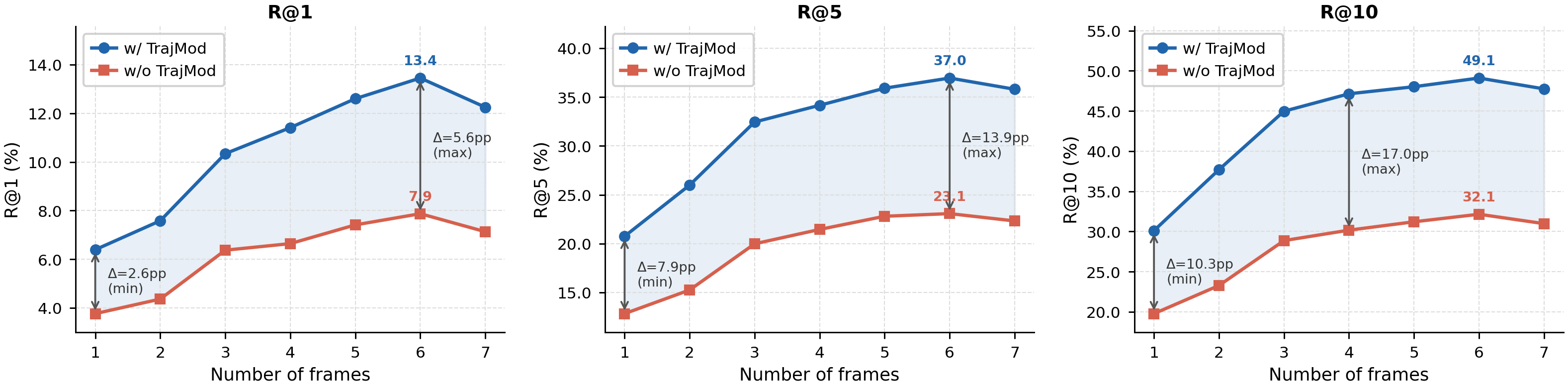
A simple blend of video and text query embeddings consistently beats the stronger single modality, with language helping most when visual evidence is sparse.
| Frames | Video | Text | Blend | Gain |
|---|---|---|---|---|
| 1 | 30.11 | 15.08 | 39.60 | +9.49 |
| 3 | 44.98 | 15.97 | 50.31 | +5.33 |
| 5 | 48.02 | 15.99 | 52.79 | +4.77 |
| 7 | 47.75 | 16.06 | 52.50 | +4.75 |
Gain is measured over the stronger single modality.
f = (1−α)fvideo + αftext · inference only, no extra parameters.
Geometry Makes the Modalities Cooperate
Anchoring video and text to the same trajectory geometry lets them reinforce each other instead of competing for capacity.
- Co-training amplifies both tasks — with TrajMod, adding text co-training lifts video R@1 from 9.69 to 12.09, and video co-training lifts text R@1 from 1.90 to 2.52.
From Spatial-Reasoning Benchmark to Agentic Tool
A spatial-reasoning testbed: can an MLLM connect egocentric route observations with their allocentric satellite footprint?
The same capability, packaged as an API-callable service: an agent sends a route description and inferred trajectory, then folds the retrieved satellite locations into its broader reasoning.
Loading the agent result…
BibTeX
@inproceedings{gao2026trajloc,
  title     = {Trajectory-aware Cross-view Geo-localization with Sequential Observations},
  author    = {Gao, Tianyi and Lin, Jiayu and Beaulieu, Danielle and Jacobs, Nathan},
  booktitle = {European Conference on Computer Vision},
  year      = {2026}
}